> For the complete documentation index, see [llms.txt](https://docs.reflag.com/llms.txt). Markdown versions of documentation pages are available by appending `.md` to page URLs; this page is available as [Markdown](https://docs.reflag.com/integrations/aws-s3.md).
# AWS S3
Export feature data for CS, Marketing, and Sales tools, via Amazon AWS S3
To configure an automatic data export to an Amazon S3 bucket, follow the steps below.
## Implementation steps
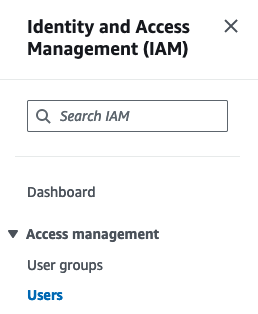
1. Log into the AWS Console. Navigate to `Identity and Access Management (IAM)` and select the `Users` option.
2. For security reasons, we recommend creating a new restricted user to access the designated S3 bucket. Use the `Create user` button to create a new user.
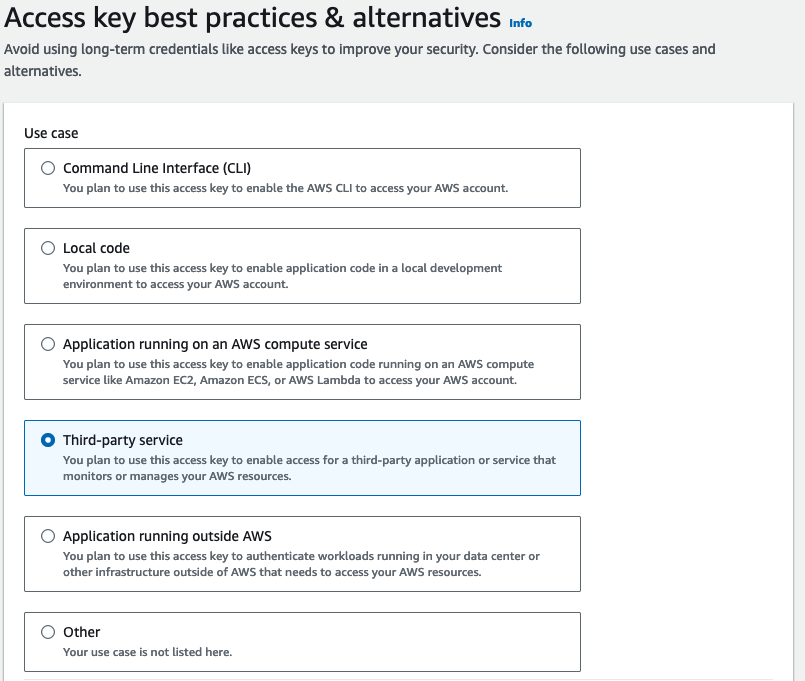
3. Select the desired user in the `Users` window, then click on the `Security credentials tab` and scroll down to the `Access Keys` section.\
\
There, click `Create Access Key` to obtain a new **Access Key** and **Secret Access Key.**
4. Copy the user's ARN (AWS unique resource number). The ARN will be required when setting up the permissions on the S3 bucket.
5. Navigate to to open the S3 configuration section.
6. Create or select an existing S3 bucket.\
\
In the bucket details pane, create a new folder (optional), and use the `Copy URL` functionality to get the public URL.\
\
This URL will be required when configuring the `Scheduled Data Export` in Reflag.
7. Switch to the `Permissions` tab of the S3 bucket details window.
8. Scroll down to the `Bucket policy` section. Normally, if no other policies have been set up, it will be empty.
9. Click on `Edit` and paste the policy below into the editor.\
\
If there are already other statements in the S3 bucket's policy, copy the statement object and paste it into the list.\
\
Replace `` and `` with the real values from your AWS account.
```json
{
"Version": "2012-10-17",
"Statement": [
{
"Sid": "AllowReflagDotCom",
"Effect": "Allow",
"Principal": {
"AWS": ""
},
"Action": [
"s3:PutObject",
"s3:PutObjectAcl",
"s3:ListBucket",
"s3:AbortMultipartUpload",
"s3:PutObjectTagging"
],
"Resource": [
"",
"/*"
]
}
]
}
```
Following the steps above should give you the **URL**, **Access Key**, and **Secret Access Key** settings required to configure an automatic data export.
---
# Agent Instructions
This documentation is published with GitBook. GitBook is the documentation platform designed so that both humans and AI agents can read, navigate, and reason over technical content effectively. Learn more at gitbook.com.
## Querying This Documentation
If you need additional information that is not directly available in this page, you can query the documentation by asking a question.
Perform an HTTP GET request on the following URL with the `ask` and `goal` query parameters:
```
GET https://docs.reflag.com/integrations/aws-s3.md?ask=&goal=
```
`ask` is the immediate question: it should be specific, self-contained, and written in natural language.
`goal` is what the user is ultimately trying to achieve, the reason they need the answer. Sharing it helps GitBook give you a better, more relevant answer. A goal is most helpful when it describes the outcome the user wants rather than restating the question. For example, with `ask=how do I create an API token`, a goal like `automate deployments from our CI pipeline` lets GitBook tailor the answer to that use case.
The response will contain a direct answer to the question and relevant excerpts and sources from the documentation.
Use this mechanism when the answer is not explicitly present in the current page, you need clarification or additional context, or you want to retrieve related documentation sections.